Microsoft Fabric data platform

A Microsoft Fabric framework, built by our experience, based on best practices

A complete, configuration-driven ETL framework deployed into your own Fabric tenant. Register a source, and the framework lands it, refines it, keeps its history and logs every run. Your team builds what is specific to your business.

Fabric · framework data flow
10+ clients
running on the framework
3 layers
bronze · silver · gold
Config-driven
a new source is a config row
History built in
audit trail and SCD2
Git native
branches and dev, test, prod
What it is

The plumbing every Fabric platform needs, already built.

A configuration-driven ETL framework that lives in your own Fabric tenant. It brings the features below on day one, so your team only builds what is specific to your business.

Configuration is metadata.

Minimal pipeline development. Pipelines read metadata at runtime.

Metadata
SourceTableBusinessKeyLoadStrategy
AdventureWorks · SQLSalesLT.CustomerCustomerIDfullscd2
AdventureWorks · SQLSalesLT.ProductProductIDfullscd2
AdventureWorks · SQLSalesLT.SalesOrderHeaderSalesOrderIDincrementaloverwrite
IonBiz · APILeavesLeaveIDincrementalscd2

load only what changed since the last run.

Full or incremental mode and the watermark column are set per table.

Watermarks
TableModeWatermark columnLast watermark
SalesLT.SalesOrderHeaderincrementalModifiedDate2026-03-04 02:00:11
SalesLT.SalesOrderDetailincrementalModifiedDate2026-03-04 02:00:11
LeavesincrementalUpdatedAt2026-03-04 02:03:47
SalesLT.Customerfull··

Helper functions are out-of-the-box.

A shared helper notebook holds all crucial logic to handle all general tasks.
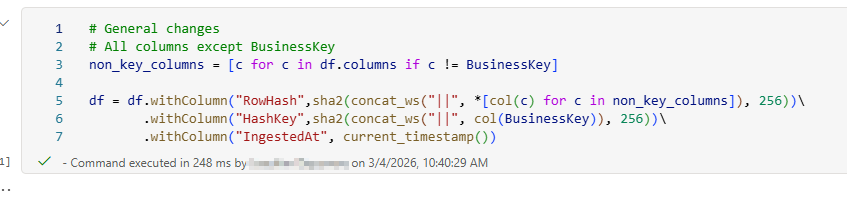
Notebook · Transformer
Notebook cells adding RowHash, HashKey and IngestedAt columns, then writing the Delta table to silver

Dependencies are baked in.

The framework derives the dependency graph between gold views them and refreshes them in the right order.
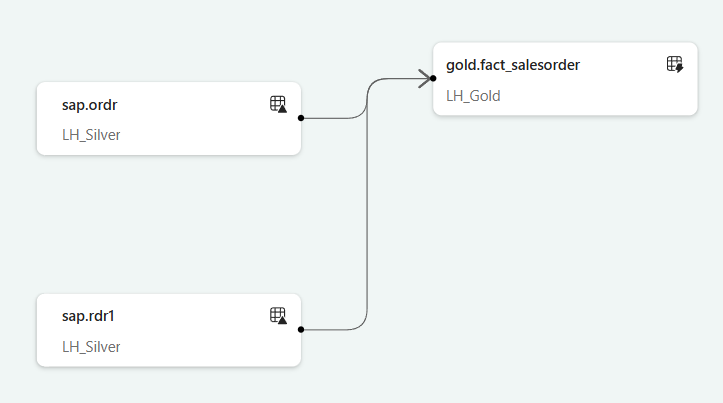
Gold · Dependencies
Materialized lake view dependency graph in the gold lakehouse: silver tables feeding dimension and fact views

Lineage is modular.

Lineage runs end to end from source through bronze, silver and gold to the semantic model. Our solution makes it visible in Microsoft Purview.
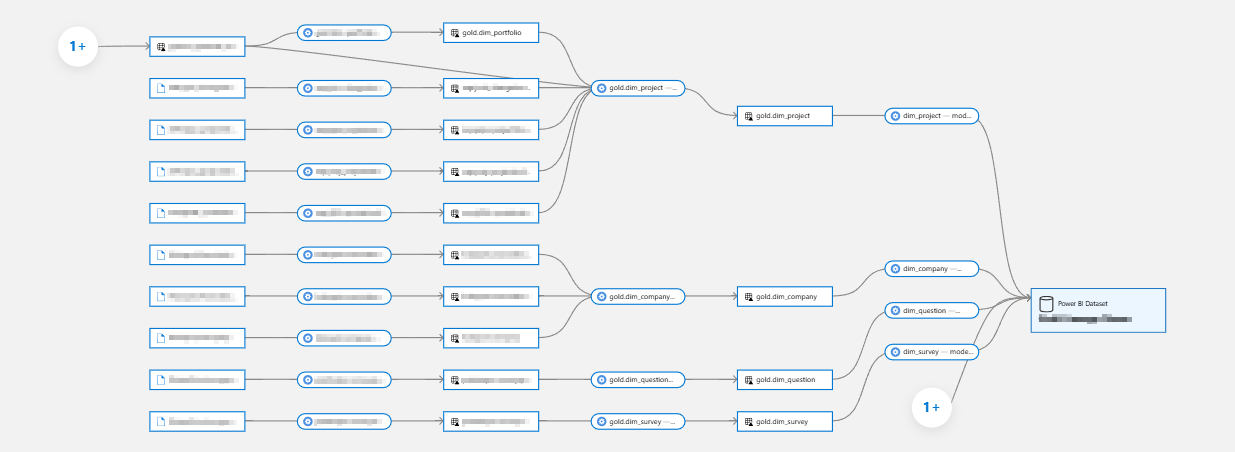
Microsoft Purview · lineage
Microsoft Purview lineage view showing the chain from source through bronze, silver and gold lakehouses to the semantic model
And more
custom source pattern duplicate and conflict policy single-source reruns central run log Maintenance schedules Key Vault secrets Variable Library environments CI automation Workspace and branch management
Why start from a framework

Spend your resources on insight, not on building.

Every Fabric platform needs the same foundations: ingestion per source, a layered lakehouse, history, logging, secrets, environments and a release process. Built from scratch, those foundations consume the first months of a project before a single report ships.

Starting from a blank workspace

Pipelines, notebooks, logging and history are designed per project and per developer. Every source is a new build, every convention a new debate, and the platform is only as robust as its first author.

Starting from the framework

The foundations are deployed on day one. Your team adds sources through configuration and spends its time on the transformations and models that are specific to your business.

Yours to keep: the framework is deployed into your own Fabric tenant and Git repository. Your engineers can read, extend and own every pipeline and notebook.

See it running on your own sources

A demo takes 30 minutes. Bring a database or an API.

Book a demo